
An 8,000 Litre Duplex Mix Tank, After a 316 Lid Rusted
A repeat customer, a Sydney manufacturer of colours and pigments, asked us to quote an 8,000 litre mix tank in 316 stainless steel. We’d built them a tank for the same product before, in SAF 2205 duplex, with the lid in 316 to save them some money. Within months, the inside of that lid was covered in rust spots. So we built this one in SAF 2205 duplex.

What the customer asked for
- An 8,000 L mix tank with a top-entry agitator
- For the same pigment product as the tank we’d built them before
- In 316 stainless steel
What happened to the last lid
The first tank we built them was SAF 2205 duplex. To keep the cost down, we made the lid in 316. It’s cheaper, and it does a good job on most food and chemical tanks.
Within months, the underside of that lid had rust spots all over it. Vapour off the product was rising, hitting the cooler lid and condensing there.
So when the order came in for a new tank in 316, we already knew how it would end. A whole tank in 316 would go the same way as that lid, only bigger and dearer to fix.
Why 316 rusts under a lid
Yes, 316 stainless steel can rust. Stainless gets its corrosion resistance from a thin chromium oxide film on the surface. Chlorides, from salt, brines, some acids and some cleaning chemicals, break that film down. Once it breaks in one spot, a pit starts, and you see it as a rust spot.
The underside of a lid is the hardest place on a tank. Warm vapour condenses there and the droplets hang. Every time they dry off and form again, whatever’s dissolved in them gets stronger. And nothing washes them off the way the product washes the shell.
So the lid can be sitting in a much nastier environment than the product. That’s why the rust turned up there first.
What 2205 duplex changes
SAF 2205 is a duplex stainless steel: roughly half austenite, like 316, and half ferrite. It carries more chromium, molybdenum and nitrogen than 316, and that’s where the extra corrosion resistance comes from.
One way to compare grades is the pitting resistance equivalent number (PREN), worked out from those three elements. The higher the number, the better the grade resists pitting.
- 316: PREN around 24
- SAF 2205: PREN around 35, and much better resistance to chloride stress corrosion cracking in warm conditions
2205 costs more than 316 and takes more care to weld, so we don’t use it everywhere. On a process water job for Baiada in Tamworth, we built the chilled water tanks in 316 and the hot water tank in 2205, because the two duties were different. The grade follows the duty. We’ve built in 2205 for chemical customers before too, like this 500 litre mobile mix tank for an adhesives maker and these jacketed contra-mix tanks.
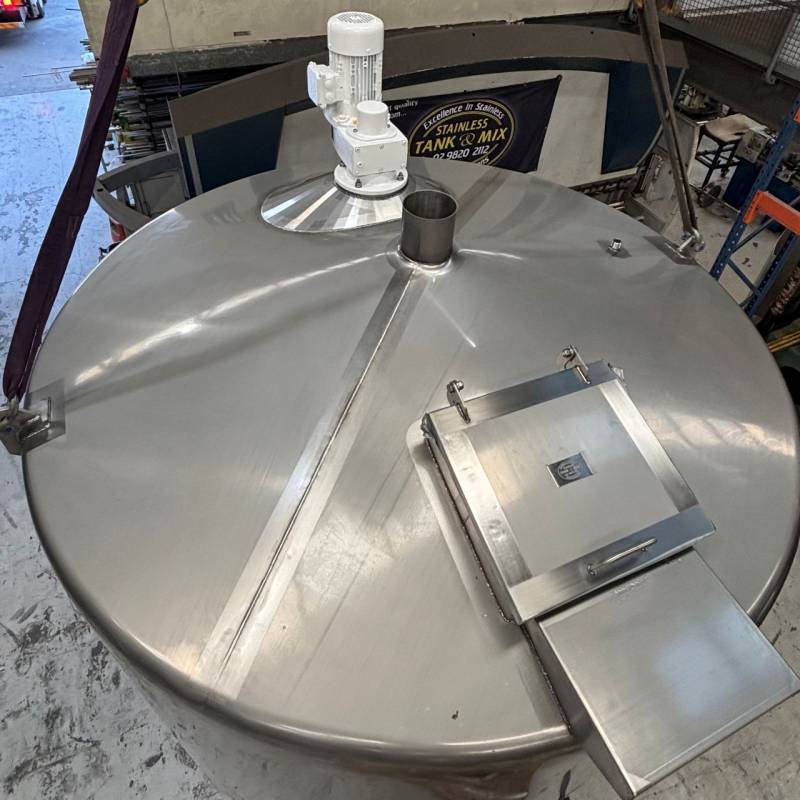
The tank
The tank is 2,300 mm inside diameter, with a 2,438 mm straight side and 15° coned top and bottom. It stands 3,546 mm tall on four legs.
Gross volume is about 10,000 litres. The space above the 8,000 L working level is normal on a mix tank, because the surface moves once the agitator is running.
- A top-entry agitator, with the gearmotor on a flanged mount on the lid and impellers at 2 levels
- A hinged inspection hatch for adding product and checking the mix
- A vent tube on the lid
- A 2″ Tri-Clamp outlet at the bottom of the cone, so the tank drains fully
- Lifting lugs on the lid
Working out the size of your own mix tank? Our guide on how to size a mixing tank goes through it step by step.

Spending it once
2205 costs more than 316. There’s no getting around that.
But a lid that rusts within months has to be repaired or replaced, and a whole tank that rusts takes production down with it. You can only spend your money once.
That’s why we ask a lot of questions before we quote. What’s going in the tank, how hot it runs, how it’s cleaned, and what happened to the last one. Most of the time, 316 is the right answer. This time it wasn’t, and we only knew because we’d seen that lid.
If you’re comparing fabricators, here’s what to ask them.
The result
An 8,000 litre SAF 2205 duplex mix tank, built for what’s going in it, for a customer who keeps coming back. And one 316 lid we won’t be making again.
All designed and built from scratch with pride and care in our Minto workshop.
Not sure which grade your product needs? Tell us what’s going in the tank and we’ll work it out with you. See our mixing vessels, our work for chemical manufacturers, or talk to us.
In this guide
Choosing a grade?
Tell us what’s going in the tank and how it’s cleaned. We’ll come back with questions, then a quote.
Request a quoteRelated solutions
Case studies
Talk to Us About Your Mix Tank
Send us the product and the volume, plus a drawing or sketch if you have one. We’ll come back with questions first, then a quote. See our mixing vessels or contact us.
