

Process Engineering Services: Plant Design, Fabrication and Commissioning for Australian Manufacturers
Request a quoteStainless Tank & Mix provides process engineering services for food, beverage, pharmaceutical and chemical manufacturers, and for contract packers. Our engineers design the process, our Minto workshop in Sydney builds the equipment, and the same team installs and commissions it.
Most of our customers know what their plant has to produce. They haven’t yet worked out what it needs to get there. That’s the work we like best, and we’ve been doing it since 1974.
We draw the process as PFDs and P&IDs, design the control system around it, model the plant in 3D and check the hard parts with FEA or CFD. Then we build every vessel, mixer, frame and pipe run, and put it all together as one working plant. The aim on every job is a plant that runs efficiently, makes good product and is easy for your operators to use.
Our Process Engineering Services
Process design
We start with what the plant has to make, how much and how often. From there we draw the process flow diagram (PFD), then the P&ID, with every vessel, line, valve and instrument tagged, and a functional description of how the system runs. Equipment selection follows the process: tank sizes, mixer types, pumps, heat transfer and cleaning. Where new equipment has to tie into an existing line, we design around what’s already there.
Design and consulting ›3D modelling, FEA and CFD
Every layout is modelled in 3D, so you can check clearances, access, operator heights and tie-ins before anything is built. Our engineers work in SolidWorks and COMSOL. We run FEA (finite element analysis) on structural and pressure parts where the job needs it. CFD (computational fluid dynamics) simulates how product flows inside a vessel, shows where the turbulence is and works out the mixer power once we know the viscosity and density. One set of IBCs for a powdered product went through numerous 3D revisions before the design was right.
3D modelling and design ›Fabrication and installation
Everything is fabricated in our Minto workshop: tanks, mixers, frames, platforms, skids and process pipework. Our own crews install it, with a crane or telehandler sized to the site, including tie-ins to plants that are still running.
Custom fabrication and pipework ›Tank installation and relocation ›Automation and commissioning
Controls are designed alongside the process. We specify the instruments, valves, VSDs and control panel, and our automation partners write the PLC and HMI code. We run a factory acceptance test (FAT) in Minto before delivery, then commission on site with a site acceptance test (SAT). If your shutdown window is tight, tell us early. Good PLC programmers book up, and we plan the job around them.
Automation ›Engineering Deliverables and Documentation
A process engineering job from STM leaves a document trail you can use for approvals, validation and maintenance. Depending on scope, you receive:
- Concept: process flow diagram (PFD) and a preliminary layout
- Design: P&IDs, functional description, equipment list, 3D model and general arrangement drawings
- Analysis: FEA reports for structural and pressure parts, and CFD studies for mixing, where required
- Fabrication: material certificates, weld procedure specifications, weld maps and passivation records
- Testing: factory acceptance test (FAT) records
- Commissioning: site acceptance test (SAT), PLC and SCADA documentation, electrical schematics, as-built drawings and operating manuals
Every drawing is revision-controlled in our Odoo ERP system, so the drawing in your maintenance file matches the equipment on your floor.
Design and Fabrication Under One Roof
When the engineer and the fabricator work for different companies, every drawing crosses a desk before it reaches the workshop. Questions take longer to answer, and a problem found on the floor turns into an argument about whose problem it is.
Our engineers and fabricators work from the same Minto site. A fabricator with a question walks over and asks it. Changes made during the build go back onto the drawing, so what you receive at handover matches what was built.
You deal with one company from concept to commissioning, and that company owns the result. If the plant doesn’t run as designed, there’s nobody else to point at.
The one piece we bring in is PLC programming, from automation partners we know. We manage them as part of the job.
Working Around a Running Plant
Most process engineering jobs land in a factory that’s already producing. Access is tight, pipework is in the way, and every hour of shutdown costs money. So we design the installation as carefully as the equipment.
For a set of 5,000 litre replacement reactors in a very difficult spot, we worked with the customer on bolt-together installation frames. They cut the downtime needed to pull the old reactors out and put the new ones in. Each reactor also got a 500 mm bottom outlet flange, so the bottom steady bearing can be serviced without anyone entering the vessel.
A 3,000 litre contra-mix kettle we rebuilt sat under a “spaghetti junction” of pipework. We took the old vessel out, installed the new one and fitted the existing pipework back in place.
Process Engineering Projects
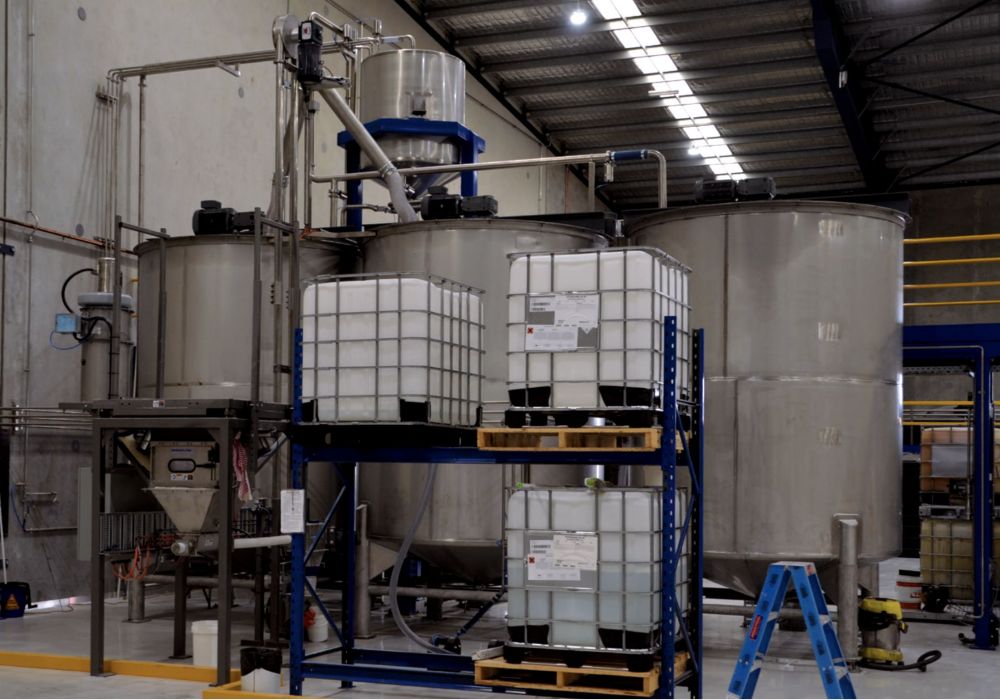
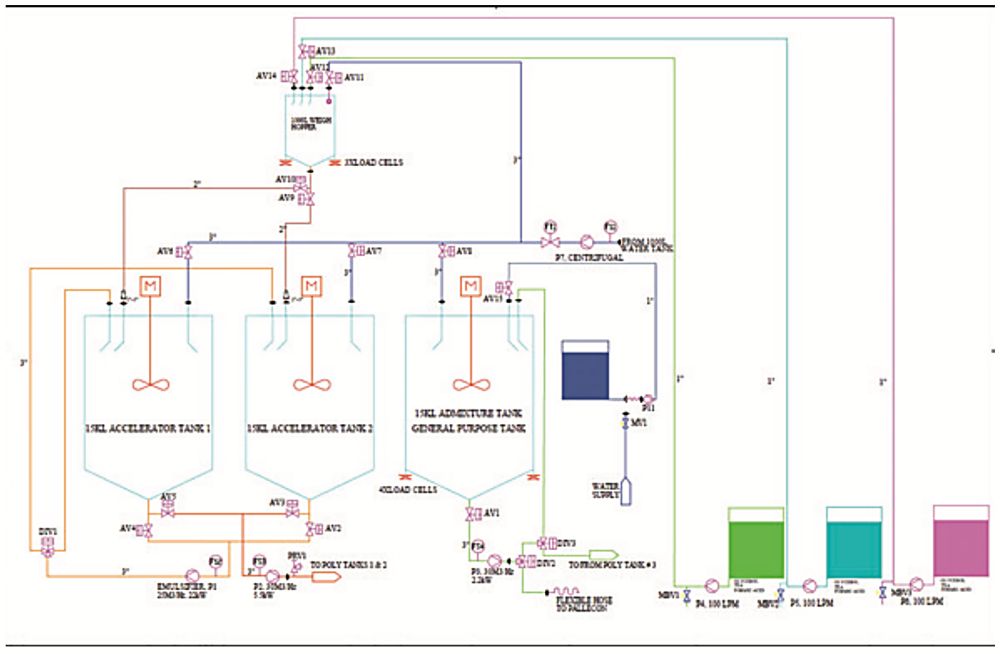
Concrete additive production plants, Sydney and Perth. An enquiry for 3 mixing tanks at a small manufacturing site turned into a fully automated concrete additive plant. We did the process design and plant engineering, the mixing systems, pre-weighing and valving, the control system and HMI, the water and compressed air supply, the electrical and control infrastructure, and the plant model and layout. Apart from the plastic storage tanks, the bulk bag unloader and the powder elevator, the whole plant came from us. Sydney was finished in July 2016. It ran well enough that the client had us build an identical plant in Perth, finished in July 2017.
Multifunction mixing system. Built so one customer could make a wide range of products on a single line. It has an anchor mixer with side and bottom scrapers, a high-shear mixer, a pitched-blade turbine, and a lobe pump recirculating through an inline emulsifier. Dry ingredients are dosed on weigh cells and liquids through flow meters. A holding tank takes each finished batch so the next one can start, which keeps 2 fillers running. CIP covers both tanks and the pipework to the fillers, and the PLC holds lockable recipes, with manual control when the operator needs it.
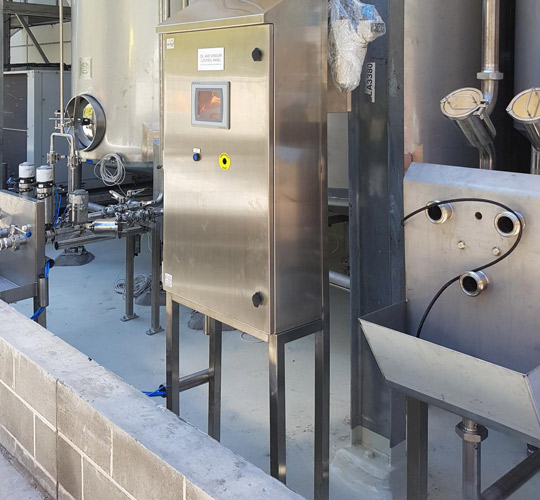
Batching and bulk storage. Bulk storage for raw ingredients, so the customer could buy in cheaper bulk deliveries. The system records what’s received and what’s used, and reports back to the mix station inside.
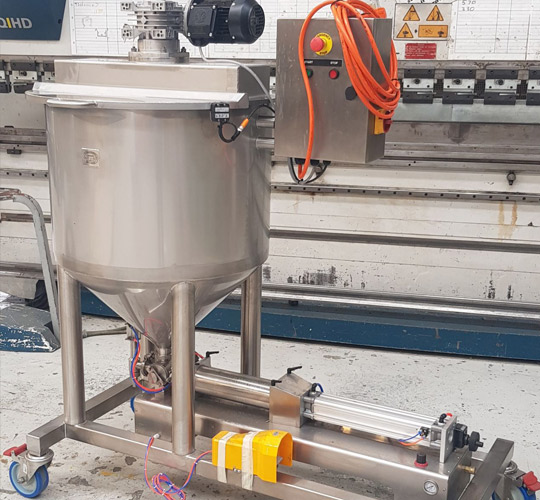
Feeder tank on a mobile skid. A feeder vessel with a cage mixer, parked directly above a filler, so a viscous product feeds without settling out.


Our Process Engineers
Justin Vuong, our process and project design engineer, joined STM in 2018 with a Masters in Engineering (Manufacturing and Management). He runs the process calculations and studies that decide the best solution.
Wamiq Qureshi, mechanical design engineer, has been with us since 2011. He builds the 3D models and P&IDs, and runs the FEA and simulation work in SolidWorks and COMSOL. Alan Toompuu, also a mechanical design engineer, brings more than 10 years in engineering and metal fabrication.
Brendan Firth, our managing director, has been solving customers’ projects since 1987. His favourite is still the customer who knows the result they want and isn’t sure how to get there.
Our Process

Concept
Understanding the brief and building a thorough scope

Design
Engineering, 3D modelling, and design approval
Fabrication
Precision manufacturing with full traceability

QA
Inspection, testing, and quality assurance
Installation
On-site assembly and integration of equipment

Commissioning & Handover
Ensuring performance and customer sign-off
Frequently Asked Questions
What does a process engineering company do?
A process engineering company works out how a plant turns raw materials into finished product: the steps, the equipment, the flows, the controls and how it all gets cleaned. At STM, we then build and install that equipment ourselves.
Do you offer process design without fabrication?
Yes. We can take a project from concept to P&IDs and a 3D layout as a design package. Most customers then have us build it, because the design is already drawn for our workshop.
What is a P&ID?
A P&ID (piping and instrumentation diagram) shows every vessel, pipe, valve, pump and instrument in a system, with tag numbers, and how they connect and are controlled. Ours come with an equipment list and a functional description of how the system runs.
What is a process skid?
A process skid is a set of process equipment (vessels, pumps, valves, pipework and instruments) built onto one frame in the workshop, so it arrives on site tested and ready to connect. We supply and put together the whole package. Controls and PLC programming come from our automation partners.
Can you upgrade or automate an existing line?
Yes. We design new equipment to tie into what’s already there, and we can automate a manual process with valve actuation, motor and VSD speed control, temperature and pressure sensing, data logging and PLC control through an HMI touchscreen.
Start With the Result You Need
Tell us what your plant has to make, how much and where it has to fit. Drawings, photos of the site and any existing P&IDs all help. We’ll come back with questions, then a concept and a quote.