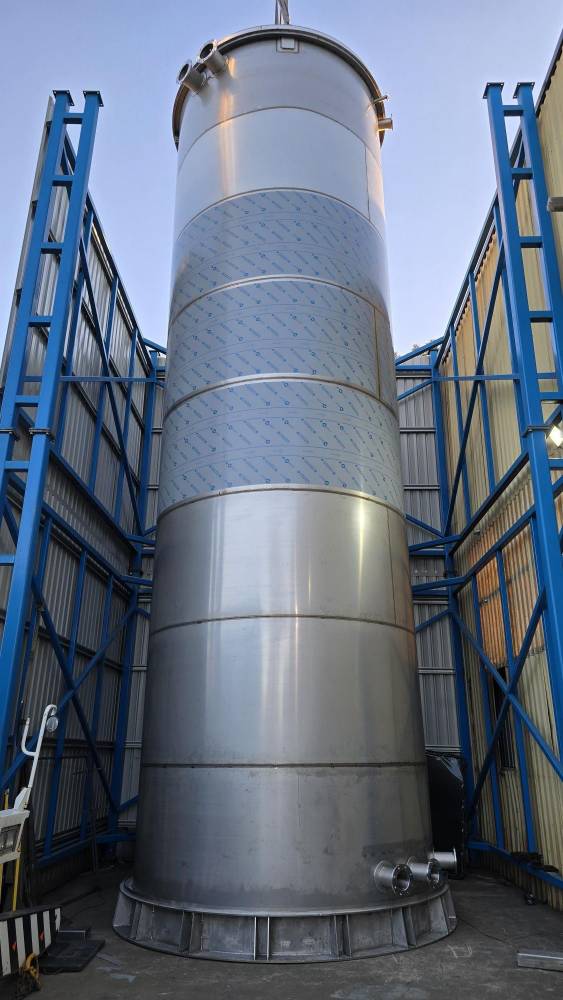
The process water storage tanks behind Baiada Poultry’s new processing plant at Tamworth hold 230,000 litres between them. We built all three — two of 100,000 litres and one of 30,000 — designed, fabricated and finished at our workshop in Minto, then delivered to site in regional New South Wales.
Three vessels, two different grades of stainless steel, two different water duties. This page covers what we built and why it was specified that way — why the hot water tank is not the same steel as the chilled water tanks, what the insulation and cladding are doing, the point at which a tank stops being something you can put on a truck, and what actually determines the cost of process water storage tanks at this scale.
We supplied the water storage. The processing lines, chilling systems and plant automation were other contractors’ scope.
What we built
Three process water storage tanks, specified around the plant’s water balance rather than pulled from a catalogue.
Two 100,000 litre tanks and one 30,000 litre tank. One of the 100 kL tanks and the 30 kL tank are 316 grade stainless steel, both on chilled water duty. The second 100 kL tank is SAF 2205 duplex, carrying hot water.
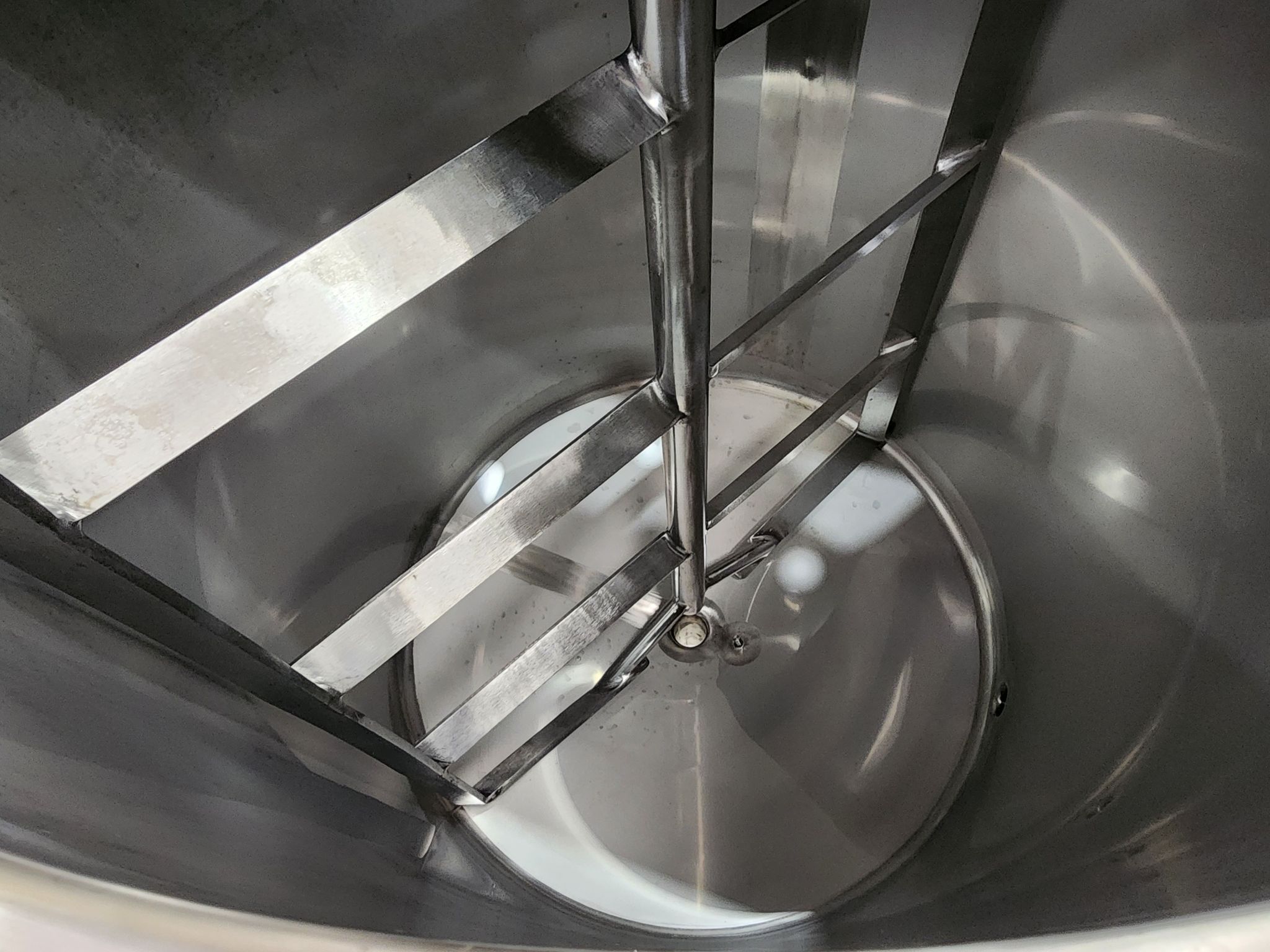
All three are insulated with 100 mm of Rockwool to the sides and top. The tops are clad in seal-welded stainless steel plate; the sides in Colorbond. Each tank carries a full nozzle schedule, including two 250NB top-entry nozzles piped down to the bottom inside the vessel — an internal downpipe arrangement that fills below the liquid surface instead of dropping water into open air, which keeps turbulence, splashing and aeration out of the tank.


Why two grades on one job
This is the part of the specification worth understanding, because it is where most tank quotes quietly differ.
316 is the standard choice for food-grade water service. It handles chlorides well, it cleans up properly, and for chilled water it is the correct and economical answer.
Hot water is a harder problem. Raise the temperature and you raise the risk of chloride stress corrosion cracking — a failure mode that does not announce itself gradually. It appears as through-wall cracking in a tank that looked perfectly sound. Duplex stainless steels such as SAF 2205 carry roughly double the yield strength of 316 and markedly better resistance to chloride stress corrosion, which is why the hot water tank on this site is duplex and the chilled water tanks are not.
Duplex is not simply better. It costs more, it is less forgiving to weld, and it needs a fabricator who works with it regularly rather than occasionally. Specifying it everywhere would have added cost to this project for no benefit on the chilled duty.
The general point for anyone buying process water storage tanks: grade should follow duty. If a fabricator quotes one grade across an entire tank farm without asking what each vessel is carrying and at what temperature, they have priced a job rather than engineered one.
What the insulation and cladding are doing
The 100 mm of Rockwool is not only about holding temperature, though it does that. On chilled duty in an Australian summer, uninsulated process water storage tanks sweat. Condensation runs down the shell and pools on the slab — a wet surface in a food production environment is a hygiene problem before it is ever a thermal one.
The cladding differs top to side, deliberately. The top is seal-welded stainless steel plate because it is the horizontal surface: it collects rain and dust, and it has to shed water completely with no seam for moisture to track through to the insulation.
Additionally, if the top of the tank is accessed, foot traffic can damage a light duty cladding which then leaks and the insulation becomes wet. Wet insulation stops insulating and starts corroding what it touches. The sides carry Colorbond, which is durable, economical and entirely adequate for a vertical surface that sheds water on its own.
Above 3.5 Metres, a Tank Stops Being a Delivery
Capacity is the number buyers ask about. Diameter is the number that decides how the tank gets built.
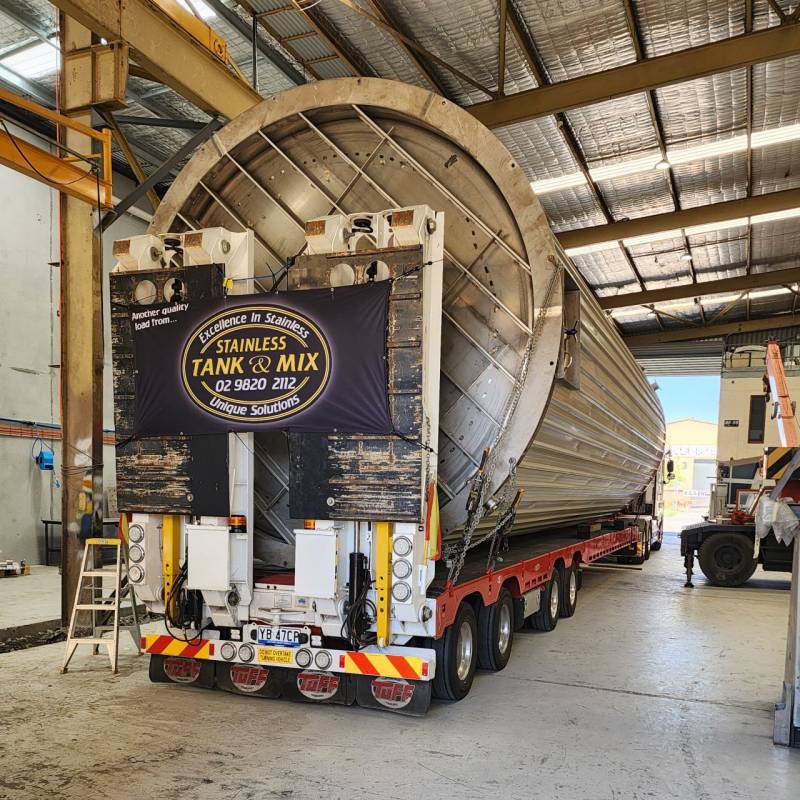
Up to 3.5 metres, a tank travels on wide-load signage and flags, at particular times of day, with no escort. Above 3.5 metres it needs an escort. Larger again and it needs a police escort. Around 7 metres is still possible, but by then the route available to you is severely restricted — and the real limits are not a number in a regulation, they are the bridges and the overhead wires between the workshop and your location on site.

Past that, the tank is not transported at all. It is built where it will stand — which in practice means moving the fabrication line to your site rather than delivering a finished vessel to it. There is no size ceiling once you are working that way: tanks of 2 million litres are routine, and considerably larger is possible.
So above a certain capacity only two things can happen. Either transport becomes the governing constraint on the design, or the build moves to your site. We work from 2 litres to 600,000 litres and beyond, and the question is never whether a capacity is possible — it is which side of that line it falls on, and what that does to your programme.
Site assembly means welding in whatever weather arrives, purge control in the open rather than a controlled bay, harder access for inspection, and a schedule exposed to everything else on that site. It can be done well. It costs more, takes longer and carries more risk than the same tank built under a roof in workshop conditions.


This matters when you are comparing quotes for large process water storage tanks. Two fabricators can quote the same capacity and be describing two entirely different projects. Ask where their transport ceiling sits, what happens above it, and which side of that line your tank falls on — before you compare the numbers.
What determines the cost
There is no list price for process water storage tanks at this size, and any figure quoted before the specification exists is a guess.
What moves it:
- Grade. Duplex costs more than 316, and 316 more than 304. On a vessel this size the material difference is substantial.
- Insulation and cladding. An insulated, clad tank is a different build from a bare shell — more material, more labour, more detailing.
- Nozzle schedule. Every nozzle is a penetration to cut, fit, weld and test. Internal pipework such as the 250NB downpipes on these tanks adds more again.
- Internal finish. The standard required for food service is not the same as for general industrial water.
- Transport or site assembly. See above. This is often the largest single variable.
- Installation. Crane access, foundations, tie-in to existing pipework, the location the tank is to be installed in relation to where a suitable sized crane can set up and safely lift the tank into position, and whether the plant is running while you work.
We will be straight about it: we are rarely the cheapest quote on the table. What we include as standard tends to be what the cheaper quotes leave for you to discover later. Send us the duty, the water chemistry, the temperature and the site constraints, and we will price the actual job.
Frequently asked questions
How much does a 100,000 litre stainless steel water tank cost?
There is no standard price. Two tanks of identical capacity can differ enormously in cost depending on grade, insulation and cladding, nozzle schedule, internal finish, and whether the tank can be transported complete or has to be assembled on site. Anyone quoting a number before seeing the specification is guessing. Send us the duty and the constraints and we will price it properly.
Is stainless steel a good material for a process water tank?
For food and beverage duty, yes. Stainless process water storage tanks do not taint the water, clean and inspect repeatedly without degrading, and handle the temperatures and chemistry of CIP cycles. Additional nozzles can be cut in at a later date, or existing nozzles modified.
What are the disadvantages of a stainless steel water tank?
Higher up-front cost than poly or lined steel, and it is unforgiving of a wrong grade selection. Put 304 where the chlorides and temperature call for 316 or duplex and the tank will not last. The material is not the risk; the specification is.
How long will a stainless steel process water tank last?
Correctly specified, welded and passivated, decades. Service life is governed by whether the grade suited the duty, whether the internal surfaces were finished properly and whether the tank is maintained inside; sludge buildup on a surface can prevent oxygen in the water from keeping the surface passive and over time the stainless steel will corrode — not by the age of the tank.
Should process water tanks be 304, 316 or duplex?
It depends on temperature, chloride content and what the water is doing. 304 suits benign duty, 316 is the usual choice for food-grade water, and duplex grades such as SAF 2205 earn their cost where temperature and chlorides combine. It is a design question, and it should be answered before anyone quotes.
Project at a glance
- Client
- Baiada Poultry, Tamworth NSW
- Tanks
- 2 × 100,000 L and 1 × 30,000 L
- Total capacity
- 230,000 litres
- Grades
- 316 (chilled water)
SAF 2205 duplex (hot water) - Insulation
- 100 mm Rockwool, sides and top
- Cladding
- Seal-welded stainless top, Colorbond sides
- Built
- Minto workshop, south-west Sydney
Planning process water storage?
Send us the duty, water chemistry, temperature and site constraints.