

Chemical Mixing Tanks and Cosmetic Process Equipment, Designed and Built in Sydney
Request a quoteStainless Tank & Mix designs and builds stainless steel chemical mixing tanks, reactors, storage tanks and cosmetic mixing vessels for Australian manufacturers. Every one is drawn and fabricated in our Minto workshop in south-west Sydney, where we’ve built for chemical makers since 1974.
A chemical tank has to suit the product first. The grade, the seals, the mixer and the drive all depend on what goes in, how hot it runs and whether it can catch fire. So we start with the product, and we ask a lot of questions before we quote.
That’s how an enquiry for a 20,000 litre tank became a 22,000 litre tank in 316, built to AS 1692 for a flammable product, with an Ex-rated gearmotor, and still under a 6.5 m roof. (The full story is further down.)
We build for industrial manufacturers of cleaning chemicals, adhesives, resins, coatings and concrete additives, and for cosmetic makers working with creams, lotions and gels. Any volume, any product, and equipment your operators can clean and maintain without a fight.
Chemical Mixing Tanks and Vessels We Design and Build
Chemical mixing tanks
Open-top and closed mix tanks, from a few hundred litres to 22,000 litres and beyond, with the mixer chosen for the job. We set the bottom shape, outlet and baffles around how you empty and clean the tank. On a pair of 300 and 600 litre tanks for mixing chemicals, a sloping flat bottom meant no unmixed product sitting in the outlet pipe, and a 10 mm mixer plate took the wear where these tanks fail first.
Mixing vessels ›Jacketed vessels and reactors
Jacketed tanks and reactors heat or cool the batch through a jacket, dimple plate or internal coils. We’ve built 5,000 litre replacement reactors with steam pipe coils, a 300 litre agitated jacketed reactor lined with PFA for chemical resistance, and a reactor that runs at 400°C. That last one needed an insulation flange and 2 cooling fans between the vessel and the gearmotor, to keep the heat out of the drive.
Jacketed vessels ›Chemical storage tanks
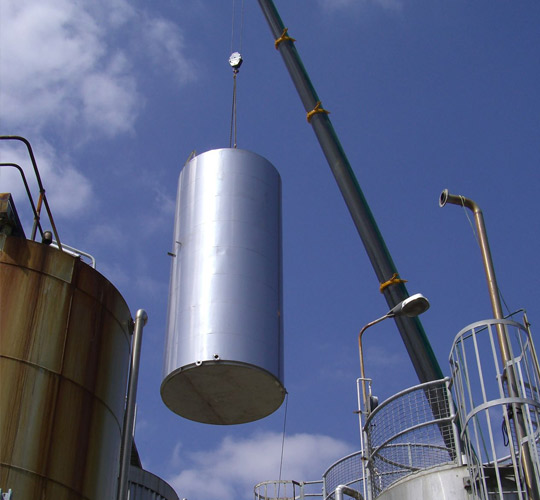
Stainless steel chemical storage tanks and silos, insulated and clad where the product has to hold its temperature. One example: a 90,000 litre 316 chemical storage tank, insulated and clad in stainless light sheet, delivered and installed in a single long day. Size raises the transport question early. Up to 3.5 m diameter travels without an escort. Past that, bridges and overhead wires decide the route, and the largest tanks get built on site.
Silos and storage tanks ›Agitators and mixers for chemical service
We design and build the mixer as well as the tank, so the two are matched. That means top-entry agitators, bottom- and side-entry mixers, cage and anchor mixers for viscous products, and helical ribbons for pastes. Side entry is easier to service, but the product must cover the shaft seal at all times, which limits small batches. We’ll tell you which suits your batch range.
Liquid blending ›Pressure and vacuum vessels
Vessels that run under pressure or vacuum are designed to AS 1210 in house, with a third-party certifier where the job calls for one. We build vacuum-rated mixing vessels that pull air out of the product as it mixes, and mobile pressure and vacuum vessels for moving product around the plant.
Pressure vessels ›Mobile tanks, IBCs and mix stations
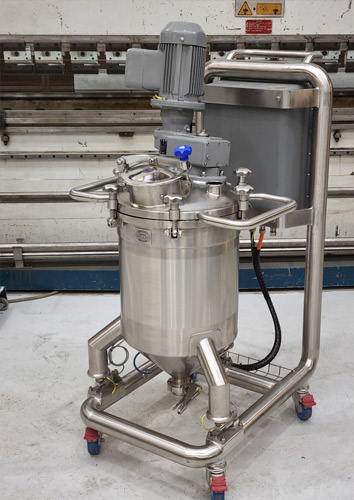
For smaller batches and shared production rooms, the tank goes to the work. We built 4 forklift-ready 2,000 litre chemical mix tanks to fit under an existing mixer, with heavy-duty outlet protection, because the outlet valve is the first thing a forklift finds. And a 75 litre Ex-rated mobile mix tank on load cells, so operators batch and dispense by weight.
Mobile tanks ›Mix stations ›Cosmetic Manufacturing Equipment
Cosmetic equipment is held to pharmaceutical-grade expectations on finish and cleanability, usually at a much smaller scale. Creams, lotions and gels are thick, sensitive to heat and good at trapping air. The mixer matters as much as the tank.
Contra-rotating mixers
A contra-rotating mixer turns an outer scraper frame one way and inner paddles the other, so product keeps moving off the wall and through the centre of the batch. It’s the usual choice for creams and thick emulsions. We’ve built them from small kettles up to 5,000 litres, with recirculation where the process needs it.
Contra-rotating mixers ›Emulsifiers and high-shear mixing
When the batch needs droplets broken down and held in suspension, we add a high-shear emulsifier, either in the vessel or inline on a recirculation loop.
Emulsifiers ›Vacuum contra-mix kettles
We rebuilt a 3,000 litre steam-jacketed contra-mix kettle, rated for vacuum and pressure, to replace one that kept breaking. The new mixer cage is stronger and cleaner, and a Cinch shaft seal can now be serviced from outside the vessel. The old seal needed a confined-space entry every time.
See the project ›Mobile mix tank sets
For a high-end cosmetics company, we built a set of mobile units: a heated cage mixer with scrapers that recirculates through an emulsifier, a heated general mix tank and a mobile storage tank. Wiring runs inside the frames, and the jacketed tanks have seal-welded cladding, so there’s less to wipe down and the insulation stays dry.
See the project ›Cosmetic manufacturers working to ISO 22716, the good manufacturing practice standard for cosmetics, get equipment designed to support it, with material certificates and finishes to match.
Materials, Codes and Safety for Chemical Tanks
The right grade and the right code come from the product, its concentration and temperature, and where the tank sits in the plant. Here’s what we work through before we quote:
- 304 stainless steel for milder products with low chlorides
- 316 or 316L where chlorides, acids or cleaning chemicals would attack 304
- SAF 2205 and SAF 2507 duplex for corrosive environments and higher chloride levels
- Hastelloy, or PFA and ETFE linings, where stainless steel alone won’t last
- AS 1692 for tanks holding flammable and combustible liquids
- AS 1210 for vessels under pressure or vacuum, with third-party certification where required
- Ex-rated motors and gearmotors matched to the hazardous-area zone the tank sits in
- Bunding where the chemical and the site call for it
- ISO 22716 support for cosmetic manufacturers
Send the product’s safety data sheet with your enquiry. It answers half our questions before we ask them.
Design Before Fabrication: a 22,000 Litre Chemical Mix Tank
The enquiry was for a 20,000 litre mix tank. It had to fit under a 6.5 m roof, with a target height of 5 m, and mix batches from 3,000 litres up to full.
The customer was setting up manufacturing in Australia, and the local team didn’t have the technical detail yet. So we worked through the customer’s overseas facilities to get our answers.
First question: side entry or top entry? A side-entry mixer is easier to maintain, but the product has to cover the shaft seal or the seal runs dry. With 3,000 litre batches in a tank this size, that rules it out, unless you fit a water flush seal and feed it a constant trickle of water. We went with top entry.
Next, the customer asked whether the mixer would homogenise the product or just stop it settling. A few more questions showed the particles dissolved easily. More agitation did the job.
Then the product turned out to be flammable. That brought in AS 1692, the standard for steel tanks holding flammable and combustible liquids, and an Ex-rated gearmotor for Zone 1, gas group IIB. The grade moved from 304 to 316 for better corrosion resistance. The feet were designed around the weigh cells the customer had chosen, and a tangential inlet let further ingredients go in without foaming.
Working volume rose to 22,000 litres, still under the roof.
Every one of those changes happened on the drawing, before any steel was cut. It’s the cheapest place to make them, and it’s why the customer got the tank they needed first time.
Chemical and Cosmetic Projects
A few more jobs from the Minto workshop:
Two jacketed contra-mix tanks in SAF 2205 duplex for a corrosive environment. Dimple plate heats them, steam injection nozzles speed up the heat-up, and both sit on a full stainless steel platform.
Two concrete additive production plants, in Sydney (2016) and Perth (2017). The first began as an enquiry for 3 mixing tanks and became a fully automated plant, with pre-weighing, valving and an HMI. The client came back for Perth because Sydney worked.
A small ETFE-lined vessel for chemical recovery at a demonstration facility.



Our Process

Concept
Understanding the brief and building a thorough scope

Design
Engineering, 3D modelling, and design approval

Fabrication
Precision manufacturing with full traceability

QA
Inspection, testing, and quality assurance

Installation
On-site assembly and integration of equipment

Commissioning & Handover
Ensuring performance and customer sign-off
Frequently Asked Questions
How does a chemical mixing tank work?
A motor-driven agitator turns inside the tank and moves the product, so solids dissolve or stay in suspension and liquids blend evenly. The product’s viscosity and the batch size decide the agitator type, its speed and where it sits. A jacketed tank adds heating or cooling through the wall.
What grade of stainless steel is used for chemical mixing tanks?
It depends on the chemical, its concentration and its temperature. Most of our chemical tanks are 316 or 316L. We use 304 for milder products, and SAF 2205 or 2507 duplex where chlorides or heat would attack 316L. Some chemicals need a lining or a nickel alloy such as Hastelloy.
Can you build mixing tanks for flammable products?
Yes. Tanks for flammable and combustible liquids are built to AS 1692, and the mixer drive is Ex-rated for the hazardous-area zone. Our 22,000 litre chemical mix tank was built this way, with a Zone 1 gearmotor.
Which mixer is best for creams and lotions?
Usually a contra-rotating mixer in a jacketed, vacuum-rated vessel, often with a high-shear emulsifier. The scraper frame keeps product moving off the heated wall, and the emulsifier sets the droplet size.
How do you size a mixer for a tank?
Start with the product’s viscosity and density, the batch range and what the mixer has to do: blend, keep solids suspended or emulsify. Those decide the impeller, the speed and the power. On larger or harder jobs, we use CFD (computational fluid dynamics) to check the mixing before we build. Our guide to sizing a mixing tank covers working volume and geometry.
Tell Us What You’re Mixing
Send us the product, the batch sizes and the space you’ve got. Include the safety data sheet if you have one. We’ll come back with questions, then a design and a quote.
Or come and see the Minto workshop, with jobs on the floor.