

The Bureau of Meteorology reckons we’re in for a hot one. Its long-range forecast for December to February, issued 5 November 2026, says daytime and overnight temperatures are very likely to be above average across most of Australia [not great news for those of us who’d rather it stayed under 22°].
For anyone running a fuel depot, a chemical plant or anywhere else with a fixed foam system, that’s a good reason to check the foam concentrate tank. Plenty of those tanks have held AFFF foam for 20 years or more, and AFFF is on its way out. The fire engineer has picked a fluorine-free foam. Now someone has to decide whether the old tank can take it.
That’s where we come in. We design and build stainless tanks in our Minto workshop, including pressure vessels designed in house to AS 1210, and a foam concentrate tank is one more liquid to store properly. Here’s what we’d want you to know before you spend the money.
Who Needs a Foam Concentrate Tank
Any site with a fixed foam system protecting flammable liquids:
- fuel terminals and depots
- chemical plants
- power stations and mine sites
- airport fuel farms and aircraft hangars
- big warehouses full of flammable goods
The fire engineer works out how much foam the system needs. The fire protection contractor installing the system usually buys the tank, and sometimes the site owner buys direct. Either way, the tank gets built to the engineer’s numbers.
Don’t expect a monster. The foam is injected into the water at a few per cent (1, 3 or 6 depending on the concentrate), so foam tanks are small next to most of what we build. The smallest we’ve made was 25 litres, and they rarely need to go past 10,000.
Atmospheric Tank or Bladder Tank?
There are two ways to hold foam concentrate, and your fire engineer will pick one.
An atmospheric tank breathes to air through a pressure/vacuum vent. When the system goes off, a foam pump or proportioner draws the concentrate out. Simple to build, easy to inspect, easy to top up. Most of the foam tanks we see are atmospheric.
A bladder tank is a pressure vessel with a rubber bladder inside. If you’ve come across bladder tanks on water pressure systems, those hold water on one side of the bladder and compressed air on the other. A foam bladder tank works a little differently. The foam concentrate sits inside the bladder, and when the system goes off, the system’s own water flows into the shell around it, squeezes the bladder and pushes the foam out to the proportioner. No compressed air, and no foam pump to fail. The shell is still a pressure vessel, so it’s designed to AS 1210.
| Atmospheric tank | Bladder tank | |
|---|---|---|
| How foam leaves the tank | Drawn out by a foam pump or proportioner | Squeezed out by system water pressure |
| Pressure rating | None, vented to air | Pressure vessel, designed to AS 1210 |
| Inspection and refilling | Open the manway, check the level, top up | Refill to the foam maker’s procedure; the bladder needs inspecting |
| Where you’d use it | Systems with a foam pump or pump proportioner | Systems that run on water pressure alone |
We’ve built both. We design pressure vessels to AS 1210 in house and bring in a third-party certifier where the job calls for it. We’ve built them from 100 litres for export up.
What to Put in the Spec
| Spec item | Why it matters | Who decides |
|---|---|---|
| 1Capacity | Set by the fire engineer’s foam calculation, plus the volume below the outlet that the system can’t use. Usually under 10,000 litres | The fire engineer. We build to the number |
| 2Grade | 304 or 316. Check the foam maker’s compatibility data, especially for a fluorine-free foam | The designer |
| 3Air contact | Concentrate keeps best with as little air above it as possible. An expansion dome or conservation vent keeps the surface small, and the tank stays full | Us, to the foam maker’s guidance |
| 4Venting | A pressure/vacuum vent sized for filling and drawing, so the tank can’t suck in or blow out | Us |
| 5Level | A sight glass or gauge you can read without opening the tank | You and us |
| 6Drain and outlet | A drain at the true low point, and an outlet set above any sediment | Us |
| 7Access | A manway and fill connection an operator can reach safely | You and us |
| 8Bunding | Sized to hold the contents if the tank leaks, to your site’s rules | The site and the fire engineer |
| 9Location | Every foam data sheet gives a storage temperature range. Shade, a shed, or insulation and stainless cladding keeps it there | You |
A word on grade. It’s usually the designer’s call, and some designers won’t look past 316. I’ve never done a chemical study to see whether foam concentrate really needs it, and for plenty of systems 304 is fine. Go by the foam maker’s data sheet and you won’t go far wrong.
Don’t skimp on the vent. We had an urgent call-out to a 250,000 litre silo damaged by vacuum after a hot wash and a cold rinse. Someone had reduced the vent line to a third of its size to stop hot caustic going over the factory floor. Full marks for keeping the floor clean. The trouble was, it turned the vent into an accident waiting to happen. A foam tank draining fast in an emergency pulls air the same way (more on vacuum damage).

And with the summer we’ve been promised, have a look at where the tank sits. A tank in full sun picks up heat on top of the air temperature.
Bring us the foam data sheet and the fire engineer’s calculation. We’ll spec and build the rest.
Keep the Old Tank or Replace It? The AFFF Change‑Out
First, the rules. NSW banned PFAS firefighting foam for training from 1 April 2021, and wider restrictions followed on 26 September 2022. They now sit in the Protection of the Environment Operations (General) Regulation 2022 (NSW EPA).
Nationally, PFOS, PFOA and PFHxS went onto Schedule 7 of the Industrial Chemicals Environmental Management Register on 1 July 2025. That prohibits their industrial use except in specific circumstances (Business Queensland). Some foam already in fixed systems falls under those circumstances, with strict limits, so check the Register against your system.
Now the tank. Some foam makers sell their fluorine-free foam as a “drop in” replacement for AFFF. The tank it drops into has had AFFF sitting against its walls for years, and PFAS doesn’t rinse off easily.
A 2025 study in the Journal of Hazardous Materials tested 4 cleaning solutions on AFFF-exposed stainless steel pipe and found complete removal extremely difficult with all of them (Nguyen et al.). Swedish researchers have measured PFAS coming back into fluorine-free foam after cleaning, which they call rebound (Bonnet et al.). Put new foam into a tank that’s still giving off PFAS, and the new foam can test positive.
So you’ve got two options: a specialist clean, with testing before and after, or a new tank. Both get used. When Brisbane Airport converted its X-Flight hangar system to fluorine-free foam, the team cleaned the existing piping with a dedicated cleaning agent and kept the system, modifying the proportioners and sprinkler heads (case study, PDF). On a big system, or an old mild steel or lined tank, a new tank can be the more certain path.
The new foam may need a different tank anyway. Fluorine-free concentrates generally need more volume than AFFF, and many are thicker, so proportioners and pumps often change too (International Fire & Safety Journal). Your fire engineer works out the new numbers, and we build to them.
Cleaning PFAS out of a tank is a job for a specialist decontamination contractor. Building the new one is ours.
My advice: get the clean-or-replace decision made before anyone orders foam. You can only spend your money once, and a clean that fails its test puts you back at square one.
What Happens to the Old AFFF Tank
An AFFF tank coming out of service still carries PFAS, so it’s handled as contaminated waste. That stays with the site owner and a licensed waste contractor, under the state EPA’s rules. We haven’t been asked to take one back yet. Once a tank has been decontaminated and cleared, it’s like any other old tank: some can be repurposed, and if all else fails it goes for scrap, mild steel parts and all.
Our part is the replacement. We measure the old tank and its connections, design the new one to fit the same footprint and pipework, and install it, cranes and access included.
We’ve done plenty of these. For a multinational chemical company, we matched the new tank’s pipework connections to the old one so the old one came out and the new one went straight back in. On another site, we replaced 7 mild steel tanks with stainless. The tanks were too heavy for the roller door, so the roof came off, the sprinkler system was disconnected, and a bigger crane than you’d think went in because of an underground tank just outside the building. Fabricating the tanks was the easy part.

Foam Tanks, and the Tanks Around Them
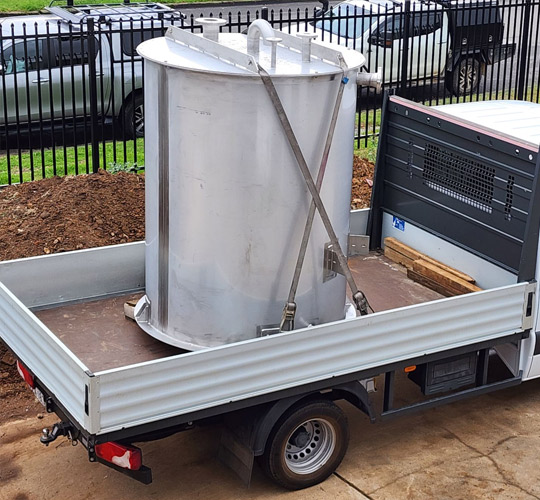
We don’t recall every foam tank we’ve built, but they’ve ranged from a little 25 litre unit up, atmospheric and bladder. We’ll build whatever size the system needs.
Foam concentrate is one more liquid that has to be stored properly, and storage tanks for chemicals and flammable liquids are everyday work for us:
- 3 × 15,000 litre storage tanks built to AS 1692, the standard for tanks holding flammable and combustible liquids
- A 90,000 litre 316 chemical storage tank, insulated and clad in stainless sheet, delivered and installed in one long day
- A 22,000 litre chemical mix tank that turned out to hold a flammable product, so it went to AS 1692 with a gearmotor rated for zone 1 IIB
- A coil-heated caustic tank in SAF 2205 duplex, and an ETFE-lined vessel for chemical recovery
When a tank is too big to travel, we build it on site. Our biggest so far is a 600,000 litre tank, built in 6 weeks at Mount Piper Power Station, Lithgow.
What to Send for a Foam Tank Quote
The more accurate the specs, the faster the quote. Expect it in 2 to 7 days. You can attach photos or drawings to your first enquiry, and we reply within 2 business hours, Monday to Friday, 9 am to 4 pm.
Frequently Asked Questions
Do all AFFF foams contain PFAS?
Yes. AFFF works because of fluorinated surfactants, and those are PFAS. Older AFFF foams contain, or break down into, PFOS or PFOA. Newer ones use shorter-chain PFAS. Fluorine-free foams are made without them.
Can I reuse my old AFFF tank for fluorine-free foam?
Sometimes. It needs a specialist clean with testing before and after, because PFAS can rebound into the new foam. The new foam may also need a different volume. Get your fire engineer to confirm both before you decide.
Does a foam bladder tank need to comply with AS 1210?
A bladder tank’s shell is a pressure vessel, so it’s designed to AS 1210. We’ve built bladder tanks, and we design pressure vessels in house with a third-party certifier where required.
What grade of stainless steel suits foam concentrate?
It’s usually the designer’s call. Some specify 316, but for plenty of systems 304 is fine. Check the foam maker’s compatibility data, because a fluorine-free foam can differ from the AFFF it replaces.
How big does a foam concentrate tank need to be?
Your fire engineer’s foam calculation sets the volume. Because the foam goes into the water at only a few per cent, most foam tanks are under 10,000 litres. We’ve built them as small as 25 litres.
How long does a foam tank quote take?
2 to 7 days, depending on how accurate the specs are. Build time depends on size and type, and we’ll give you a date with the quote.
In this guide
Changing foams?
Send the foam data sheet and photos of the existing tank, and we’ll tell you what we’d build.
Request a quoteRelated solutions
Case studies
Talk to Us Before You Change Foams
A foam change is the right time to get the tank right, because once the money’s spent, it’s not there to spend again.
Call us on (02) 9820 2112, or send the foam data sheet and photos of your existing tank through our contact form, and we’ll tell you what we’d build.
All our tanks are designed and built from scratch with pride and care in our Minto workshop. If you can think it, we can build it, and do it better.